+91-9925390425
 +1-832-647-8304 (USA)
 info@papayacare.com
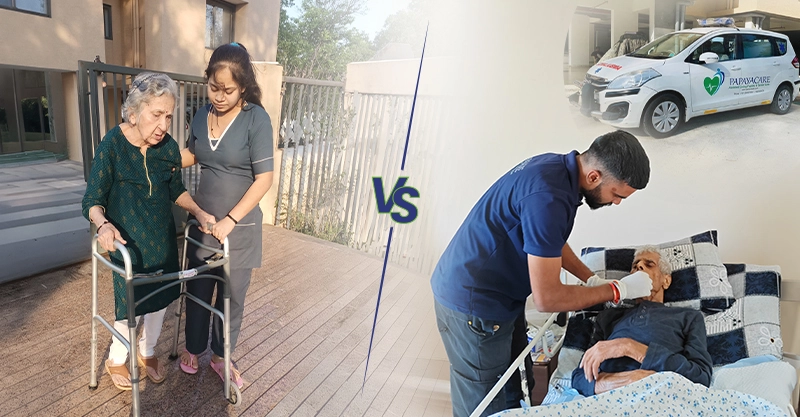
Most families assume keeping an attendant at home is the cheaper option. It sounds right, and it feels kinder.
Then the other bills start. The physiotherapist. The diapers. The rented hospital bed. The replacement attendant when the first one leaves without notice.
Here is what both options actually cost, with nothing left out.
Quick Answer
- Dependent parent at home: ₹60,000 to ₹1,20,000 a month, everything counted
- Standard assisted living: ₹40,000 to ₹75,000, or ₹45,000 to ₹85,000 with extras
- Independent parent at home: ₹30,000 to ₹53,000 a month
- Shared-room assisted living: ₹15,000 to ₹30,000 a month
In both cases the facility works out lower, and includes a nurse on duty at night, doctor rounds, physiotherapy, meals and emergency cover in one bill. (prices are vary based on condition)
Why Families Get the Comparison Wrong
Families put an attendant’s salary next to a facility’s fee. Those two numbers cover completely different things.
- A facility fee is a bundle already assembled for you
- Home care is a bundle you assemble yourself, at retail prices, vendor by vendor
- One live-in attendant is not 24-hour care. They sleep, eat and rest. Real round-the-clock cover needs two people on shifts
What a Home Attendant Really Costs
| Caregiver type | Monthly range |
|---|---|
| Untrained live-in attendant | ₹18,000 to ₹28,000 |
| Trained caregiver | ₹25,000 to ₹35,000 |
| GNM or qualified nurse | ₹35,000 to ₹60,000 |
| ICU-trained nurse | ₹50,000 to ₹75,000+ |
| Two attendants for true 24-hour cover | ₹36,000 to ₹60,000 |
Then come the bills nobody quotes you:
| Add-on | Monthly range |
|---|---|
| Attendant’s food and stay | ₹3,000 to ₹6,000 |
| Agency and replacement fees, spread over a year | ₹2,000 to ₹5,000 |
| Physiotherapy, three visits a week | ₹4,000 to ₹9,000 |
| Doctor visits or teleconsults | ₹1,500 to ₹5,000 |
| Medicines, diapers, dressings | ₹4,000 to ₹12,000 |
| Equipment rental: bed, air mattress, oxygen | ₹3,000 to ₹8,000 |
| Cook or housekeeping | ₹4,000 to ₹8,000 |
| Extra electricity, AC through the night | ₹1,500 to ₹4,000 |
| Ambulance and hospital runs, averaged | ₹2,000 to ₹5,000 |
| Total add-ons | ₹25,000 to ₹62,000 |
Salary plus add-ons puts a dependent parent at home in the range of ₹60,000 to ₹1,20,000 a month.
What Assisted Living Already Includes
- Room with senior-safe fittings
- Three meals plus tea, planned for diabetes, BP, kidney or soft-diet needs
- Nursing staff on duty in shifts, so someone trained is awake at 3 am
- Routine doctor rounds and medicine administration on record
- Daily physiotherapy or mobility sessions
- Housekeeping and laundry
- Activities, bhajan and celebrations that keep a senior engaged
- Security, emergency protocol and hospital tie-ups
- Staff cover during leave, at no extra cost to you
| Facility type | Monthly range |
|---|---|
| Shared accommodation | ₹15,000 to ₹30,000 |
| Standard, private room | ₹40,000 to ₹75,000 |
| Specialised memory or high-dependency care | ₹80,000 to ₹1,50,000 |
Billed separately: specialist consultations, medicines, hospital transport, a dedicated one-to-one attendant, salon services. Budget 15 to 20 percent above the base fee.
The Comparison That Settles It
What each service costs if you buy it separately at home:
| Service | Separately at home | Assisted living |
|---|---|---|
| 24-hour caregiver cover | ₹36,000 to ₹60,000 | Included |
| Nurse available at night | ₹35,000 to ₹60,000, or unavailable | Included |
| Doctor rounds | ₹1,500 to ₹5,000 | Included |
| Physiotherapy | ₹4,000 to ₹9,000 | Included |
| Dietician-planned meals | ₹6,000 to ₹12,000 | Included |
| Housekeeping and laundry | ₹4,000 to ₹8,000 | Included |
| Medical equipment | ₹3,000 to ₹8,000 rental | On site |
| Emergency response | One person, if awake | Trained team |
| Cover during staff leave | You arrange and pay | Included |
| Monthly total | ₹60,000 to ₹1,20,000 | ₹45,000 to ₹85,000 |
You cannot buy nine services from nine vendors for less than one provider already running all nine under one roof.
The Cost Per Hour View
- An attendant at ₹18,000 to ₹28,000 works out to ₹25 to ₹40 an hour on paper
- But they sleep and rest, so you get 10 to 12 active hours. Real cost: ₹50 to ₹95 an hour, one person, one skill level
- A facility at ₹40,000 to ₹75,000 works out to ₹55 to ₹105 an hour, and buys a share of a nurse, doctor, physiotherapist, dietician, kitchen, housekeeping and emergency team
At home you buy one person’s time. In a facility you buy a share of an entire team’s time, for about the same money.
In Ahmedabad and Gujarat
Gujarat sits below Delhi, Mumbai and Bangalore on care costs, which works in your favour.
- Live-in attendant: ₹18,000 to ₹28,000 a month
- Qualified nurse: ₹35,000 to ₹60,000 a month
- Shift-based caregiving: ₹1,250 to ₹1,500 per shift, which is how the total climbs
- Quality assisted living near Ahmedabad: ₹15,000 to ₹30,000 shared, ₹40,000 to ₹75,000 private
Families from Vadodara, Rajkot, Surat, Gandhinagar and Mehsana choose facilities near Ahmedabad for hospital access, and because the same budget buys more care here than in a metro.
One Family’s Numbers
A Vadodara family kept their father home after a hip fracture. The plan was one attendant at the lower end of the range.
By month three they had two attendants, a physiotherapist three times a week, a rented hospital bed and air mattress, weekly consumables, and they had changed attendants four times. Their outgo had reached the top of the ₹60,000 to ₹1,20,000 band.
What moved them was not the money. Their father fell reaching for the bathroom at night while the attendant slept in the next room, and nobody found him for close to an hour. The facility quote was lower than what they were already paying.
Anonymised with the family’s permission.
When Home Care Is Still the Right Choice
We will say this plainly. A home attendant is the better option if:
- Your parent is mobile and mentally sharp, and another adult lives in the house full time
- The need is short and defined, say six weeks after a minor procedure
- Family lives close enough to reach them in minutes
If that is your situation, keep them home and spend a little on senior-proofing the house.
For everyone else, home care is not cheaper. It is billed in smaller pieces, so it feels cheaper.
Signs You Are Already Paying Facility Money
- Paying two attendants, or paying one and worrying about the nights
- Changed attendants more than twice this year
- A fall or a near miss in the last six months
- Medicines missed, doubled or muddled
- More than two hospital admissions this year
- Unexplained weight loss
- Buying diapers, dressings or consumables every week
- Renting a hospital bed, air mattress or oxygen concentrator
- The main family caregiver is exhausted or losing sleep
- You live in another city or abroad and manage all of this on calls
Three or more, and your monthly outgo is already inside the facility range. Five or more, and you are paying facility money for home-level care. Our guide on when to consider assisted living covers the next step.
Ask Any Facility for These in Writing
- Nurse-to-resident ratio, and how many nurses are on duty at night
- How fast a nurse reaches a room at 3 am
- Doctor visit frequency and hospital tie-ups
- Whether physiotherapy is included, and how many sessions
- Who pays for medicines and consumables
- What the cost becomes if your parent’s condition worsens
- Notice period and refund policy
- A full itemised list of everything billed separately
Any facility that hesitates to give you that list has told you something useful. Our guide to choosing a facility covers the rest.
Get a Written, Itemised Cost
We will tell you honestly if a home attendant suits your family better. We often do.
If a facility is the right answer, PapayaCare will assess your parent’s actual needs and give you a written monthly cost with every inclusion and every extra listed. No surprises in month three.
Call us, message us on WhatsApp, or book a visit to our Ahmedabad facility. Most families tell us afterwards that it cost less than they assumed and included more than they expected.
View our assisted living services or start the admission process.