+91-9925390425
 +1-832-647-8304 (USA)
 info@papayacare.com
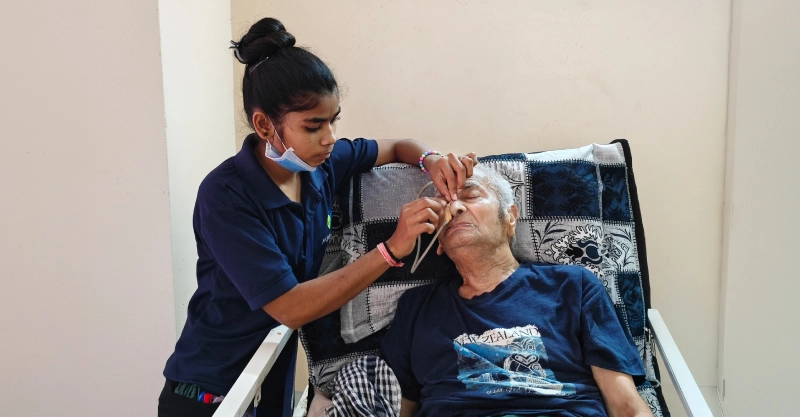
Your parent just got discharged after a hip replacement. The doctors say they are stable. But home means stairs, no grab bars, complex medications, and you are in London, Sydney, or New Jersey, not Ahmedabad.
This is the reality for millions of Indian families. Children building lives abroad, parents aging in India. The love is there. The distance is too.
Post-hospitalisation care exists for exactly this situation, supervised recovery, in a home-like environment, so elderly parents heal properly, and families abroad stop worrying.
This guide explains what post-hospitalisation care actually involves, when assisted living is the right next step, and what good care looks like in practice.
- 1 in 5 elderly patients in India is readmitted to hospital within 30 days of discharge – most due to lack of structured post-discharge care (HCAH, 2025)
- 40% of seniors experience a fall within the first week of returning home after hospitalisation – the home environment is simply not set up for recovery
- Over 75% of elderly patients in India live with at least one chronic condition requiring daily monitoring – diabetes, hypertension, cardiac disease, or a combination
- Seniors receiving structured post-hospital rehabilitation recover up to 3x faster than those resting at home without guided physiotherapy (WHO Rehabilitation Data, 2023)
- 70% of seniors say loneliness and lack of social engagement are their biggest concerns in daily life – structured assisted living directly addresses this
- Less than 10% of Indian families currently use professional senior care – meaning most families discover its value only after a crisis, not before one
The Gap Nobody Warns Families About
Hospitals discharge patients when they are medically stable, not fully recovered. For elderly patients, the first 30 days after discharge are the highest-risk window. This is when falls happen, medications get missed, infections return, and readmissions peak.
Part-time helpers and concerned relatives cannot provide what this phase actually requires — clinical monitoring, medication management, and structured rehabilitation. By the time something goes wrong, most overseas families are managing a crisis over a phone call.
Post-hospitalisation care closes this gap before it becomes one.
What Post-Hospitalisation Care for Seniors Includes
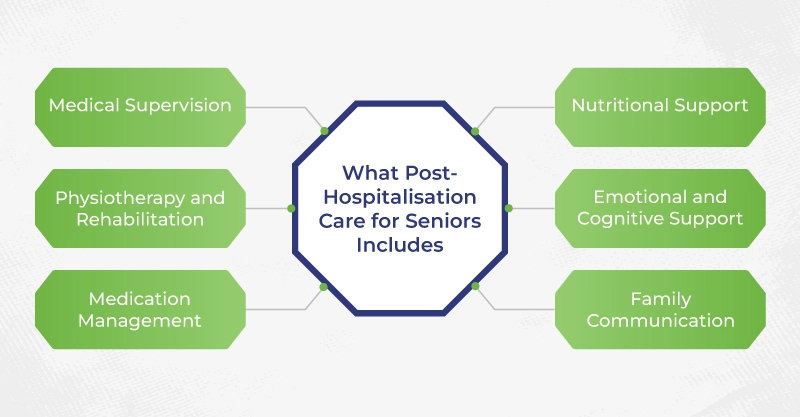
Medical Supervision: Wound care, vitals monitoring, and direct coordination with the treating hospital. Any change in condition is caught early, not noticed days later.
Physiotherapy and Rehabilitation: Structured movement and strength work after surgery, stroke, or prolonged bed rest. Guided rehab is what restores function; rest alone does not.
Medication Management: Post-discharge prescriptions are often new, multiple, and adjusted. Trained staff managing medications daily removes the single biggest risk factor for elderly readmission.
Nutritional Support: Appetite and digestion are compromised after illness or surgery. Structured meals calibrated to the patient’s conditions directly affect recovery speed.
Emotional and Cognitive Support: Post-hospital disorientation and anxiety are common in elderly patients. Routine, social interaction, and professional support are clinical inputs, not soft extras.
Family Communication: For families in the US, UK, Australia, or Canada, regular updates from the care team mean you are not managing your parent’s recovery on incomplete information.
Why “Rest at Home” is Not Enough
Home feels like the right place after the hospital. For most elderly patients, it is not set up for recovery.
No clinical monitoring. Bathrooms without support bars. Meals that are not calibrated for healing. A part-time helper who cannot assess whether a change in behaviour is a medication side effect or something more serious.
Professional post-hospitalisation care for seniors is not a replacement for family. It is the practical solution to a structural gap that neither home nor love can fill alone.
When Post-Hospital Care Becomes Assisted Living
The hospitalisation is often what reveals that home is no longer the right long-term arrangement.
Assisted living is the right next step when:
- A senior lives alone and cannot safely manage daily tasks
- Chronic conditions need daily monitoring, not occasional check-ins
- Early dementia makes the home environment unsafe
- The family is abroad, and part-time help is not sufficient
- The home layout itself, stairs, isolation, and distance from medical care are risks
Moving to assisted living is not a step down. For most overseas families, it is the arrangement that finally gives their parents a consistent, quality daily life.
What This Means for Families in the US, UK, Australia, and Beyond
NRI families who contact PapayaCare share one concern: they want their parent to have the care they would give themselves — if they could be there.
What PapayaCare offers overseas families specifically:
- No uprooting – parents stay in India, in a familiar cultural setting, with food, language, and surroundings they know
- Direct communication – regular updates from the care team, not through intermediaries
- International contact line – PapayaCare is reachable at +1-832-647-8304 for families abroad
- Full care under one roof – post-hospital recovery, assisted living, dementia care, ortho and neuro rehab, palliative care – no need to move facilities as needs change
- Premium care at Indian costs – the standard NRI families expect, without requiring a parent to leave India
A parent who would resist moving abroad adjusts well to a quality care home in India, familiar food, familiar festivals, and people who understand their world.
What to Look for in a Senior Care Facility
Clinical questions to ask:
- Is there 24/7 nursing — not just scheduled visits?
- Are physiotherapists and physicians available on-site?
- Which hospitals is the facility partnered with for emergencies?
- Can it handle complex conditions — dementia, post-surgical, neuro, ortho, palliative?
Environment questions:
- Is it designed for elderly residents — safe floors, lighting, bathroom fittings?
- Does it feel like a home, not a ward?
Family communication questions:
- How often do families receive updates?
- Is there a dedicated contact for overseas families?
Cultural fit questions:
- Is the food appropriate for elderly Indian residents?
- Do staff speak Gujarati or Hindi?
- Are Indian festivals and routines part of daily life?
How PapayaCare Supports Both Needs
Hospital Recovery Care
- Post-surgery and post-illness recovery with clinical oversight
- Coordination with the discharge hospital and treating specialists
- Physiotherapy and rehabilitation built into the daily schedule
- Medication management, wound care, vital sign monitoring
- Ortho, neuro, cardiac, and post-ICU care pathways
Assisted Living
- Individual care plans are developed with the physician and family
- 24/7 nursing supervision and emergency response
- Help with personal care, meals, and mobility
- Social, recreational, and cognitive engagement daily
- Dementia, palliative, psychiatric, and hospice care are available
Your parent does not need to leave India for premium, home-like senior care. PapayaCare brings that standard to Gujarat.
Looking for Trusted Senior Care for Your Parents in India?
Speak with PapayaCare today to understand the right care option for your loved ones.

Call / WhatsApp

International / NRI